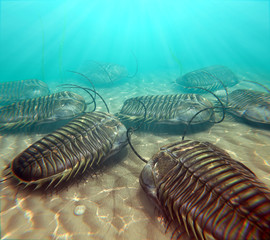
Trilobites were one of the most ancient arthropods on the planet. They first appeared about 540 million years ago in the early Cambrian Period. What paleontologists know about them comes from their fossils, which are basically imprints of their exoskeletons formed in rock. Trilobites were strictly aquatic organisms thriving in the early Ordovician and Cambrian oceans. There were over 600 species, surviving at least 250 million years until they went extinct toward the end of the Permian Period.
The word trilobite means “three lobes,” and the creatures had a unique three-lobed and three segmented body structure. These three segments consisted of the tail-shield (pygidium), abdomen (thorax), and head-shield (cephalon). Under the tough exoskeleton, trilobites had six legs in three pairs attached to the head and a pair of legs for each pleural groove.
When they were alive, the trilobites’ cephalon and pygidium were fused, giving them the ability to curl into a ball for protection. Paleontologists have discovered that the Calymene Specimens from the Silurian Era could defend themselves in this manner.
However, trilobites, like other arthropods, sometimes outgrew their exoskeletons and had to molt. When they needed to shed, trilobites would find a safe location because they were vulnerable without their shells. Paleontologists and biologists suggest that molting in these arthropods was triggered by hormones. The bulging central portion of a trilobite’s cephalon is called the glabella. The cheeks on each side of the glabella had facial sutures, which helped the animal slip out of its exoskeleton when molting.
Even though discoveries have shown us that some trilobites were blind, most of them had eyes. In fact, trilobites are one of the most ancient animals with vision. Their eyes were located on the glabella cheeks. Generally, trilobites had compound eyes, which are made up of many lenses. However, the eye structures varied significantly from one trilobite to the other. Some had huge convex compound eyes similar to a housefly’s, with 360 degree vision, while others had small stalked eyes, resulting in a narrower field of vision. But their eyes were not the trilobites only sense. They also had canals, pits, and tubercles on their exoskeleton that allowed them to detect and understand their environment.
Like virtually all arthropods, paleontologists believe that trilobites reproduced sexually. It is assumed that mating occurred shortly after molting when the exoskeleton is still soft. There has been only one report of discovered fossilized eggs (in 2017) from the Cambrian eodiscid trilobites.
After emerging from eggs, trilobites underwent three distinct morphological phases: the protaspid, meraspid, and holaspid stages. However, what we know of their ontogeny is limited to how their exoskeletons changed, because that is the only evidence they left. Therefore, there is no knowledge of any early stages of trilobites that do not have a calcite exoskeleton. However, what paleontologists do know is that segments were added to the trilobites as they evolved.
In the holaspid stage, adults kept growing until environmental constraints stopped them. Some trilobites grew to huge sizes of over two feet in length. At the same time, some were barely an inch long.
 Chase Pipes