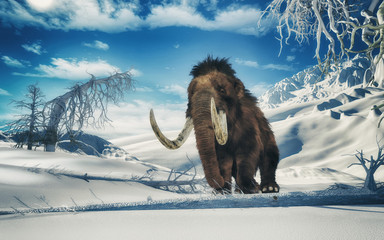
Woolly mammoths walked the earth for millions of years till most of them died 10,000 years ago. They first emerged in Siberia and spread over North America and Eurasia. These hairy elephant relatives have fascinated us since they were first discovered. They completely vanished 4,000 years ago as a result of a warmer planet and extensive human hunting. Humans used their carcasses to construct shelters and fashion tools and musical instruments from their gigantic tusks.
However, it wasn’t the humans that caused these hairy elephant cousins to disappear entirely. After a team of geneticists from St, John’s College at the University of Cambridge in England analyzed historical environmental DNA from the Arctic, they established that melting icebergs caused the giants to go extinct. The earth became too moist for them to thrive because the food they required was no longer available.
But isolated populations on St. Paul Island and Wrangel Island persisted for generations after most had died out. When scientists compared the DNA of the Wrangel Island mammoths with Asian elephants and older mammoths, they discovered a group of genetic alterations. The researchers found issues with the genes needed for smell, brain development, and sperm production. These mutations threatened the mammoth species by weakening their ability to smell flowers, a vital element of their diet.
After the last Ice Age, the Pleistocene, which concluded some 11,000 years ago, mammoth populations diminished. But the Wrangel and St. Paul Island discoveries revealed that they lasted past the Ice Age in various parts of the Arctic. Their lived into the Holocene Period, our current era.
Woolly mammoths coexisted with humans for 2,000 years, sharing the era of the Pyramids. Therefore, the extinction of the mammoths is the most recent large-scale natural extinction event.
For a long time, many scientists believed that humans were to blame for the extinction of the creatures. The reasoning was that they had existed for so long and thrived until they coexisted with humans, and then they died out. It was erroneously believed that we hunted them to extinction. This research has proven that there were many other factors, not just climate change, that caused their end. After the Ice Age, the planet changed too quickly for mammoths to adapt. Forests and wetlands replaced the mammoth’s preferred grasslands. But the woolly mammoths were good at surviving in the cold, and they flourished by eating grass, flowers, and other plants. They would use their tusks to sweep the snow away and use their trunks to pull up the roots of sturdy grasses. According to fossil discoveries, mammoths existed on every continent except South America and Australia.
If anything, the lesson from the mammoths demonstrates the severity of drastic climate change. There are many modern animals on the verge of extinction, like mountain gorillas, pandas, and Indian elephants. Understanding the mammoths’ demise can put us in a better place to stop the loss of another species. From the mammoth story, biologists and zoologists have learned that when population levels fall under a certain threshold, genetic damage may become irreversible. While genetic testing might be a technique to ensure a species’ genetic variety is sufficient for its survival, stopping the numbers from dropping to non-recoverable levels is simply a better choice.
 Chase Pipes