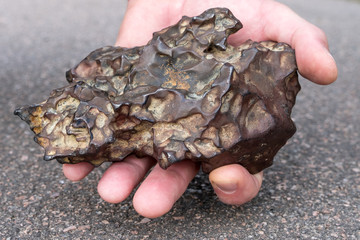
A meteorite is a piece of a meteoroid that has traveled through space and landed on a planet. When meteoroids collide with the Earth’s atmosphere, gravity and heat cause them to temporarily flare – then they become meteors.
Meteorites fall into three major categories:
iron meteorites (5 percent of total found)
stony meteorites (94 percent of total found)
stony-iron meteorites (1 percent of total found)
Each of these groups features different varieties – therefore, there are many subcategories.
Scientists suggest that iron meteorites are from asteroid cores that melted away in their lifetime. Most of these asteroids are thought to have come from the Asteroid Belt between Jupiter and Mars. Several asteroids melted when the solar system was still in its early formation. The iron in these asteroids was dense and sank, forming metal cores. Iron meteorites are the result of that dense movement. Therefore, they respond very strongly to magnets. These meteorites are mainly comprised of iron-nickel metal combined with carbide minerals and sulfide. However, the metal component ranges from 90-95 percent of the total meteorite mass.
Stony meteorites, the most common kind of meteorite, come from the outer surfaces of planets or asteroids. Consequently, they are difficult to differentiate from other earth rocks if one doesn’t know what to look for. Most stony meteorites still have enough metal to be attracted to a strong magnet. They also have a black fusion crust, which is formed on the surface as it falls through the atmosphere.
Chondrites are stone meteorites that contain chondrules, a result of a solar nebula. Chondrites are old and predate the genesis of our planet, making them the most ancient matter that astronomers and geologists can study. Their Greek name, “chondres,” means “sand grains.” Chondrules are small and grain-like, containing silicate minerals combined with tiny grains of iron-nickel alloys and sulfides. These are the solar system’s building blocks, and they have remained the same over the eons. Chondrites reveal a lot about the formation of the solar system.
On the other hand, meteorites without chondrules are called achondrites. They are extraterrestrial volcanic materials that developed as a result of volcanic activity (igneous). The recrystallization and melting removed all traces of the ancient chondrules. Consequently, achondrites do not contain iron, and because of this, they are more difficult to discover since they do not respond to magnets.
Earth, Mars, Venus, and Mercury, which all have rocky layers, were created through this igneous differentiation process. In this process, the magma cools and hardens, creating a formation with concentric layers. Therefore, studying achondrites may reveal a great deal about how Earth is structured and how it was formed.
Last, stony-iron meteorites are the least common of the three major categories, making up under 2 percent of all found meteorites. They are composed of relatively equal parts of iron-nickel metal and silicate minerals. These meteorites are regarded as the most alluring types of space rocks, and they often contain precious gemstones. Stony-iron meteorites fall into two distinct subgroups: mesosiderites and pallasites.
Pallasites, named after German biologist and adventurer Peter Pallas, are known to be rocks with a nickel-iron composition densely surrounding olivine crystals. In turn, these crystals shimmer an emerald green when they are sufficiently pure.
In contrast, the smaller, extremely rare nickel-iron and silicate mesosiderites reveal an appealing black and silver composition when cut and polished. The term “mesosiderite” comes from the Greek, and means “half iron.”



 Leading the Smoky Mountain Relic Room, Chase Pipes collects, identifies, and sells affordable artifacts, gems, and minerals that allow the public to take home a piece of history. Regularly traveling into the field to source finds, Chase Pipes has extensive knowledge of meteorites.
 In addition to overseeing the Smoky Mountain Relic Room in Sevierville, Tennessee, Chase Pipes’ career involves Chasing History, a show featuring a range of topics in American archaeology. As a hobby, Chase Pipes is a historical reenactor who depicts life on the frontier during the Revolutionary War, which took place in the 18th century.

 Chase Pipes